
What might change if I took Jesus’ words seriously?
Scripture
John 4:28-30
Read this passage slowly before the teaching. Its English Standard Version wording appears in quotation marks inside the teaching below; everything outside quotation marks is original explanation written for this study.
The conversation has turned a corner. She has heard Jesus speak about living water, she has been told the truth about her own life without being dismissed for it, and she has heard Him say who He is. Then John records one of the quietest, most ordinary details in the whole Gospel: "So the woman left her water jar and went away into town."
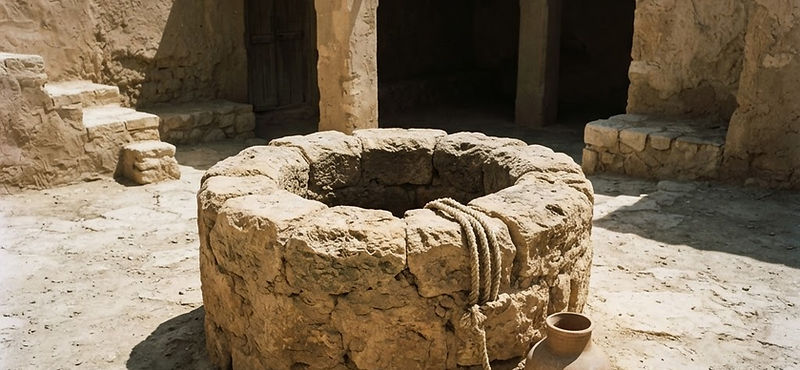
The jar matters. It is the reason she walked to the well in the heat. It is the thing she came for. And now she sets it down and goes, and John does not stop to explain why. He does not tell us that she abandoned her home, her work, or her responsibilities. He does not tell us that she never came back to the well. He tells us that she left her water jar and went into town.
We should be careful not to make that detail carry more than it does. Some retellings turn one set-down jar into a total renunciation of a former life. That is a satisfying story, and it is not what the text says. What the text says is smaller and, in its own way, more believable: the errand that had organised her afternoon suddenly was not the most important thing in it.
She goes into town and says, "Come, see a man who told me all that I ever did. Can this be the Christ?"
Look at how modest that invitation is. She does not preach. She does not claim to have worked anything out. She asks a question. She gives them the one piece of evidence she actually has, which is what happened to her, and then she leaves the conclusion open: can this be the Christ? She is not certain enough to instruct them, and she is too persuaded to stay quiet.
And the town comes. "They went out of the town and were coming to him."
There is a pattern in how Jesus changes a life here, and it is not the pattern we usually expect. He does not begin with a demand. He begins with a gift, then with the truth, then with Himself. Her response is not a project or a resolution. It is a direction: away from the well and toward the people she knows, carrying a question.
That is worth sitting with. We often imagine that following Jesus properly would require a dramatic rearrangement, an announcement, a completely different life by Monday. What the passage actually shows is one woman setting down one jar and walking in a new direction with an honest question. The rest of her life is left unrecorded, which is a mercy, and also an invitation.
In the song
The song's turning point is not a resolution but a reordering: the fictional woman's priorities shift when she is met rather than used. She is not the Samaritan woman, and the video does not depict John 4. What connects the two is the smallness of the change, a person setting something down because something greater has taken its place.
For reflection
Optional, and private. Answer one, answer all, or simply sit with the question.
Saved in this browser only. These notes are never sent to us, never stored on our servers, and never included in analytics.
For discussion
For a small group, a friend, or a long walk.
- Her invitation was a question rather than an argument. What does that suggest about how we invite people to consider Jesus?
- Leaving the jar was one small, specific act. Why might small obedience matter more than large intentions?
A prayer
Lord Jesus, You met a woman in the middle of an ordinary errand and gave her something worth leaving the errand for. Show me what I am carrying that has quietly become more important than You, and give me the willingness to set it down today rather than someday. Amen.
Key takeaway
An encounter with Jesus rearranges what we carry, one ordinary thing at a time.
Where biblical text appears in quotation marks on this page, it is the ESV® Bible (The Holy Bible, English Standard Version®), copyright © 2001 by Crossway, a publishing ministry of Good News Publishers. Used by permission. All rights reserved. Paragraphs without quotation marks are teaching written for this study, offered as explanation rather than as Scripture.